World's Smallest Bodybuilder Dies at Age 23


Geoff Caddick/PA Wire/AP PhotoThe world's tiniest bodybuilder, Aditya 'Romeo' Dev, died today at age 23.

World's Smallest Bodybuilder Dies at Age 23 - Early this morning, Dev was rushed to Satyam Hospital in Punjab, India, where doctors were unable to revive him.

"He was brought to the hospital in an unconscious state," Dr. Nerraj Chandanone at Satyam Hospital told The Daily Mail. "It was due to massive bleeding which had caused brain damage or aneurism bleeding. There were very rare chances of him surviving."

In 2008, Dev had been diagnosed with two brain aneurisms, a common symptom of being a dwarf. Doctors had warned Dev that at any time, without warning, his aneurism could burst and lead to a fatal stroke.

Dev's father, Anil Dev Sharma, 53, and mother, Rakesh Bala, 49, are devastated at the news of their son's death.

"He was absolutely fine until last night when he suddenly fell unconscious. We rushed him to the hospital and he fell into a coma, he was unconscious all night. Doctors said the nerve supplying blood to his brain had ruptured, causing his death," Sharma told local reporters. "It's a huge loss for our family, we will be grieving his death for the rest of our life. We were told by doctors many years ago that he may die at an early age. All these years we prayed for his long life."

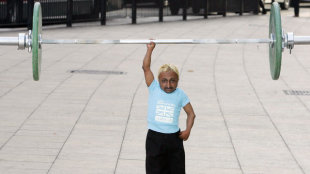
Standing at only 2 feet, 9 inches and a mere 19 pounds, Dev told " Good Morning America" in 2009 the most he ever lifted was 10 pounds - about half his weight.

"From the very beginning I liked lifting the dumbbells and lifting weights," he said through a translator. "I used to watch wrestling when I was a small kid and that's how I got inspired."

His hard work paid off. The Guinness Book of World Records dubbed him the world's smallest body builder in 2006.

In 2009, Dev told "GMA" he considered himself to be the strongest dwarf in the world. He used a regimen that included 3.3-pound custom-designed dumbbells from his trainer and was able to bulk up to the size of an average 2-year-old.

His chest measurement was 20 inches and his exercise routine included aerobics and dance. Dev said he never let his size stop him from doing anything, even though his height was only about as tall as a baseball bat. ( ABC News Blogs )


READ MORE - World's Smallest Bodybuilder Dies at Age 23

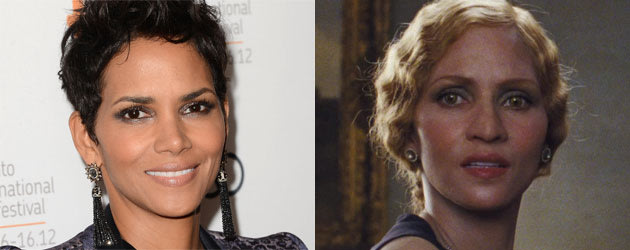
Halle Berry, Xun Zhou racially transform in ‘Cloud Atlas’


Halle Berry transforms into a white woman in 'Cloud Atlas.' (Photo: Jason Merritt, Getty Images/Warner Bros. P …

Halle Berry, Xun Zhou racially transform in ‘Cloud Atlas’ -- By now, most everyone knows "Cloud Atlas" is a mind-bending, epic tale spanning centuries -- within which individual characters are reborn. Many of the leading actors in the film portray several different people in different eras, with different hair color, and sometimes appearing as a different race, even gender.

Halle Berry, who is biracial, and Chinese actress Xun Zhou do some race-bending in the film. Both of them portray white women at two different points in the epically long 2-hour, 44-minute cinematic journey, made by the creators of "The Matrix" and "Run Lola run" (the Wakowski siblings, and Tom Tykwer, respectively). Incidentally, South Korean actress Doona Bae -- who is getting a lot of buzz for her performance in "Atlas" -- also transforms into a white woman at a certain point.

Berry plays a litany of characters in the film, but the white woman she portrays is Jocasta Ayrs, a not-so-true, rather kinky wife of a composer (Jim Broadbent).


Xun Zhou also transforms into another race in 'Cloud Atlas.' (Photo: Getty Images/Warner Bros. Pictures)

And Zhou's white character is the wife of Tom Hanks in the far future when the world has gone to hell. SPOILER: She and her family eventually get killed by a cannibalistic Hugh Grant.

Along with crossing racial lines with the help of heavy makeup -- and in some instances prosthetics and eye contacts -- Hugo Weaving and James D'Arcy bend their genders by playing women. Weaving is especially memorable as the evil Nurse Noakes.

And Berry takes it even a step further: She plays an old Korean male doctor at one point in the film.

To make all the race-bending more fun, Jim Sturgess also transforms into an Asian character. ( Movie Talk )


READ MORE - Halle Berry, Xun Zhou racially transform in ‘Cloud Atlas’

Pope wants to stay in simple residence for now


Pope wants to stay in simple residence for now - Pope Francis wants to stay for the time being in a simple Vatican residence instead of moving into the spacious and regal papal apartments, the Vatican said on Tuesday.

The former Cardinal Jorge Bergoglio of Argentina is still living in the Domus Santa Martha, a modern hotel-style residence inside the Vatican City where he stayed during the conclave that elected him on March 13.

http://l.yimg.com/bt/api/res/1.2/uHbYEPgfV8W7xseDXSPj.A--/YXBwaWQ9eW5ld3M7Y2g9Mjk0O2NyPTE7Y3c9NDUwO2R4PTA7ZHk9MDtmaT11bGNyb3A7aD0yOTQ7cT04NTt3PTQ1MA--/http://media.zenfs.com/en_us/News/Reuters/2013-03-26T151559Z_1_CBRE92P16F900_RTROPTP_2_POPE-FRANCIS.JPG
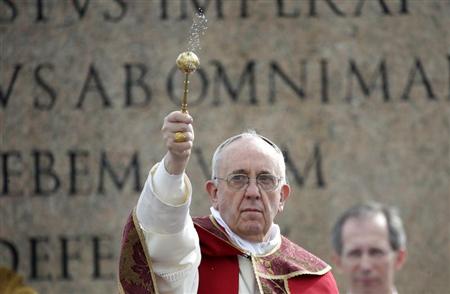
Reuters/Reuters - Pope Francis sprinkles holy water with an aspergillum as a blessing during the Palm Sunday mass at Saint Peter's Square at the Vatican March 24, 2013. REUTERS/Max Rossi

Although the papal apartments in the Apostolic Palace - which consist of more than a dozen rooms as well as quarters for staff and a terrace - are available, he shows no desire to move in any time soon, Vatican spokesman Federico Lombardi said.

In the past few days Francis has moved out of a single room in the residence, which has some 130 rooms, into a suite so he could have more space to work and to receive people, Lombardi said.

Francis has set a more austere tone for the papacy than his predecessor Benedict XVI, who gained a reputation for sumptuous costumes. Lombardi says the new pope enjoys the residence's community atmosphere where he lives alongside other clergy.

The pope says Mass in its chapel every morning and invites Vatican workers and other guests to attend.

"I can't make long-term predictions, but for now it seems he is experimenting with this type of simple co-habitation," Lombardi said.

"It is still a period of getting used to things, of experimentation. Certainly in this phase he has expressed the desire to stay where he is," he said.

Lombardi said the pope will be using the offices in the Apostolic Palace and its grand, frescoed reception rooms to meet heads of state and delegations, and will continue to appear each Sunday to deliver a blessing from the window of the papal apartments overlooking St. Peter's Square. ( Reuters )


READ MORE - Pope wants to stay in simple residence for now

Careers for People Who Prefer to Work Alone


Best Solo Act Careers

Are you looking for a job that offers plenty of alone time? Keep reading to learn more about six careers that don't require rubbing elbows or schmoozing.

Careers for People Who Prefer to Work AloneWhen you visit the office water cooler, do you prefer to talk to yourself? Do you tend to spell "team" with a "me" on the end?

We get it. You don't exactly hate having co-workers, but you do feel more at ease when they're not around all the time.

In short, you prefer to work alone, which makes finding the right career fit pretty important.

"Some people are much more comfortable working alone," says Suzanne Anthony, a clinical psychologist. "You spend a large part of your life at work, so you want it to be a place where you are comfortable," she adds.

So if your goal is to make the office that place where you go for some quality "me" time, check out these six solo-friendly career options.

Career #1: Medical Records and Health Information Technician


If you want to help others for a living, but prefer a more behind-the-scenes role, consider preparing to pursue a career in medical records and health information technology.

In fact, the U.S. Department of Labor says that these workers generally spend many hours in front of computer screens.

That's because technicians are typically in charge of documenting and managing patients' health information, like medical histories, test results, symptoms, and insurance information, adds the Department of Labor.

Sounds like a pretty people-free job, right?

Education options: Eager to learn more about working with health data? Technicians usually need a postsecondary certificate or associate's degree in health information technology to get started in this field, according to the Department. In addition, many employers could require professional certification.

Career #2: Accountant


Perhaps you've heard the saying "numbers don't lie." Well, that's probably because they're not people. And since numbers are what accountants generally deal with, this might be a great career for those who need some people-free time.

Don't take our word for it, though. According to the U.S. Department of Labor, accountants generally inspect, organize, and manage financial records to make sure they are accurate and comply with laws and regulations. In addition, they could calculate taxes owed and prepare tax returns.

So ask yourself, the last time you balanced your checking account or did your taxes, how many people wanted to help? Odds are you answered "none."

Education options: Got your sights set on pursuing a career as an accountant? Know this: The Department of Labor says most accountant positions require at least a bachelor's degree in accounting or a related field. Of course, some employers like to see a master's degree in accounting or in business administration with an accounting concentration, adds the Department.

Career #3: Computer Programmer


In Stanley Kubrick's classic movie "2001: A Space Odyssey," a spaceship is controlled by HAL 9000, a computer with a mind of its own. While that's still a figment of Hollywood's imagination, computer programming is probably still a good choice for workers seeking a people-free zone.

Why? Because computer programmers essentially tell computers how to function - and we're guessing that's pretty much a one-way conversation.

As for the general responsibilities, the U.S. Department of Labor notes that computer programmers often write code to turn the program designs of software developers and engineers into instructions the computer will follow. You might also spend your time debugging and testing programs.

Education options: Most computer programmers have a degree in computer science or a related field, according to the Department of Labor. And while a majority of programmers earn a bachelor's degree, the Department says that some employers will hire candidates with an associate's.

Career #4: Survey Researcher


 If you've got an inquisitive mind, a solo-friendly career as a survey researcher could be the right fit for you.

According to the U.S. Department of Labor, these are usually the workers who design and conduct surveys and then analyze the collected data for everything from scientific to marketing research. In fact, survey researchers could cover a wide array of fields, such as government, health, education, and social sciences, says the Department of Labor.

And good news for solitary types: the Department says survey researchers often work alone when they're designing surveys and analyzing data.

Education options: Survey researchers could have a bachelor's degree in various fields such as psychology, business, and political science, according to the Department. Technical and advanced positions may require a master's degree, says the Department, which adds that some survey researchers choose degree programs in survey research, survey methodology, or marketing research, while others earn a master's in business administration.

Career #5: Graphic Designer


Are you a creative type who loves spending quality alone time on your computer? A career as a graphic designer could be the solo act opportunity you're looking for.

Graphic designers are the guys and gals that might get to listen to their iPod for creative inspiration at work. And what is that work? According to the U.S. Department of Labor, graphic designers could choose everything from colors and images to text styles and layouts for brochures, ads, websites, and more.

And while it's true that graphic designers often work as part of a team, many designers work independently. And some even telecommute, says the Department of Labor. So, theoretically, you could be a world away from your fellow workers.

Education options: Ready to get your graphic design groove on? The Department says that a bachelor's degree in graphic design or a related field is generally required. "However, those with a bachelor's degree in another field may pursue technical training in graphic design to meet hiring qualifications," adds the Department.

Career #6: Market Research Analyst


Are you fascinated by what people want or need but don't necessarily want to be around them yourself? Consider pursuing a career as a market research analyst.

According to the U.S. Department of Labor, these are the people who comb through research data to define what products and services consumers want and what they will pay for them. Common duties could include monitoring sales trends, keeping track of how their company's competitors are doing, and preparing reports about their findings - without an overabundance of face-to-face time.

Education options: Ready to research? The Department of Labor says that market research analysts typically need a bachelor's degree in market research or a related field. And "many have degrees in fields such as statistics, math, or computer science," adds the Department.

But note that many research analyst positions require a master's degree, especially for leadership positions or jobs with more technical research, according to the Department. In fact, many analysts complete degrees in fields like marketing or earn a master's in business administration. ( education.yahoo.net )


READ MORE - Careers for People Who Prefer to Work Alone

Hot Wheels sets a real-life record for a corkscrew jump in a car


Hot Wheels sets a real-life record for a corkscrew jump in a car - It may look like a toy, but the car in mid-barrel roll above is a life-sized, 2,600-lb. dune buggy built by Hot Wheels and driven by Brent Fletcher attempting to set a world record for a corkscrew jump in an automobile. It looks fun in mid-air, but the landing shows these kind of stunts aren't child's play.

The latest in a string of big stunts from the toy car concern, the trick follows the six-story double loop-the-loop stunt at this year's X Games and the world-record 332-ft jump by Tanner Foust at last year's Indianapolis 500. This stunt runs much shorter by comparison at 92 feet, but it's much more difficult to control how much the car will rotate during the ride. Tracy had to hit the ramp at exactly 54 mph to make the calculations work, rotating 230 degrees per second and hitting the orange ramp with his tires instead of his roof.


At 92 feet, Hot Wheels says this bests any previous corkscrew jump, like the one Chevy did for a Super Bowl ad earlier this year, or the progenitor of the move, the James Bond stunt in "The Man With The Golden Gun." See for yourself from every conceivable angle below.


READ MORE - Hot Wheels sets a real-life record for a corkscrew jump in a car

Islamophobia, Sikhophobia and Media Profiling


Islamophobia, Sikhophobia and Media ProfilingOn Sept. 11, 2001, terrorist attacks shook the American nation to its core. Nineteen individuals associated with al Qaeda coordinated to hijack four passenger jets and use them as weapons of mass destruction. The terrorist attacks of 9/11 claimed approximately 3,000 lives, including all 256 passengers on the four planes, 125 people at the Pentagon and more than 2,600 people at the World Trade Center.

The global community watched the destruction and devastation with horror. Law enforcement agencies focused attention on detecting and preventing further terrorism on American soil, while news media scrambled to collect, synthesize and present an enormous amount of information in a remarkably short period of time. Photos and videos of the destruction flooded the news media, and these representations characterized the terrorists responsible for the attacks as fitting a Muslim, Arab or Middle Eastern profile. As a result, Islamophobia began to sweep across the nation.

Reports and studies demonstrate that an increasing mistrust of Muslims fueled a violent post-9/11 backlash throughout the U.S. Within a week of the terrorist attacks, Arabs, Muslims and South Asians registered more than 1,000 incidents of criminal discrimination, including murder, assault, vandalism and verbal harassment. According to crime statistics compiled by the Federal Bureau of Investigation (FBI), anti-Muslim hate crimes in the U.S. increased by 1,600 percent between 2000 and 2001. Furthermore, a study funded by the U.S. Department of Justice found that approximately 75 percent of hate crimes are not reported in official FBI statistics.

It is also important to note that Islamophobic violence is not a thing of the past, and unfortunately, we don't have to look far to find a tragic example. A couple of months ago, five children in San Diego lost their mother in a hate-crime. Shaima Alawadi, an Iraqi-American, was brutally beaten to death in her own home. Her daughter found her corpse in the living room, along with a note that read: "go back to your country, you're a terrorist."

In August of 2010, Time Magazine ran an article about the controversy surrounding the construction of an Islamic center near Ground-Zero, and the cover of that particular issue asked the question: "Is America Islamophobic?"

The national attention on President Obama's religious background, the scandal related to NYPD surveillance of local Muslims, Quran burning displays in Florida -- these are all recent examples of how Islamophobia operates within our society.

Strikingly, Muslims have not been the only targets of Islamophobic violence. A number of different American communities have been impacted by Islamophobia, and practitioners of the Sikh religion make up one of the most adversely affected minority groups. The distinctive physical appearance of typical Sikh males in particular -- brown skin, turban, beard -- correlates with the stereotypical images of terrorists projected in western media. Scholars have recently described this perceived relationship as a racialization of religious identity. This process has led to a conflation of Sikhs and Muslims, and therefore, has produced a corollary to Islamophobia -- Sikhophobia.

In fact, the first casualty of a hate crime in post-9/11 America was a Sikh-American named Balbir Singh Sodhi. According to official reports, his murderer said he killed Sodhi because "he was dark-skinned, bearded, and wore a turban."

In other words, Sodhi fit the profile of "the Islamic other."

With law enforcement and news media fanning the flames, the increasing sense of Islamophobia has led Sikh-Americans to be publicly profiled as suspicious and threatening. For instance, the day after the 9/11 attacks, a turbaned Sikh male named Sher Singh was traveling from Boston to New York on an Amtrak train when it stopped in Providence, R.I. The FBI had sent federal agents, local police and bomb-sniffing dogs to arrest him. Officers rushed to the platform, pointed rifles at Singh and shouted "Get your f--- hands up." The officers removed him from the train at gunpoint and handcuffed him. According to a report by the American-Arab Anti-Discrimination Committee, bystanders gathered around Sher Singh during the time of his arrest and began shouting obscenities and hate-speech, such as: "Kill him!" "Burn in Hell!" and "You killed my brother!" Strikingly, Sher Singh reported that one of the arresting officers joined in the vitriol by asking, "How's Osama bin Laden?"

Neha Singh Gohil and Dawinder S. Sidhu have pointed out that the arrest of this Sikh-American male, as well as its widespread publicization, wrought major damage to the image of Sikhs in the immediate aftermath of 9/11.

"News stations replayed the video of his arrest in connection with its coverage of the attacks, thus associating Singh and other turbaned Sikhs with the planners of the attacks. ... Thus any connection between terrorists and a turbaned male with a long flowing beard was further embedded in the hearts and minds of emotional Americans. On the contrary, no media coverage followed news of Sher Singh's release, just three hours later. There was no reason -- beyond the turban and long beard -- for the public or law enforcement personnel to be concerned about his presence on a train. In other words, he did nothing to arouse suspicion, aside from looking the way he did in a public space."

Despite his innocence and relatively quick release, news stations continued to replay the arrest and detention of Sher Singh for the next three days, and this continuous loop helped shape and perpetuate basic stereotypes of "the Islamic other." Moreover, the mutually reinforcing actions of racial profiling by the federal government and news media offered the general public with a sort of sanctioning of Islamophobia and Sikhophobia.

The consequences of these attitudes have been severe and costly. Since 9/11, tens of thousands of Americans have been alienated and victimized. The overly simplistic profile of "the Islamic other" has done more harm than good, and it has negatively affected Muslims and non-Muslims alike. From job discrimination and school bullying to racial profiling and police surveillance, the various manifestations of Islamophobia continue to divide the nation and increase tensions.

It's time to leave behind our Islamophobic, Sikhophobic and other-phobic tendencies and look at one another as fellow human beings.

We can't afford to produce more examples like Sher Singh, Shaima Alawadi and Balbir Singh Sodhi. ( huffingtonpost.com )


READ MORE - Islamophobia, Sikhophobia and Media Profiling

American Sikhs A Small, Misunderstood Community


American Sikhs
In this Saturday, April 29, 2006 photo, children with U.S. flags march down Broadway during the 19th Annual Sikh Day Parade in New York. Since Sept. 11, 2001, many Sikhs have been mistaken for Muslims and have become targets. As a result, they have been at the forefront of civil rights advocacy against religious and racial profiling. (AP Photo/Hiroko Masuike)

American Sikhs A Small, Misunderstood Community --- Ever since they arrived in the U.S. as farmers and lumber mill workers in the late 19th century, Sikhs have struggled with how little Americans knew about the faith.

In 1907, a mob in Bellingham, Wash., who called Sikhs "the Hindus," ran them out of town. (Bellingham officials apologized formally 100 years later.)

Over time, they established themselves in the United States with major temples from Boston to California. Still, they remained a small, often misunderstood community, readily identifiable by their turbans. During the 1970s Iranian hostage crisis, Americans often mistook Sikhs for Iranians. Vandals attacked some temples after the Oklahoma City bombing, committed by white U.S. Army veteran Timothy McVeigh.

So when the Sept. 11 attacks occurred, the Sikh community immediately began organizing, working closely with U.S. Arabs and Muslims on domestic anti-terror policies that respect civil rights.

"When you walk out, all eyes are on you. You get used to it, but it's tough," said Vishavjit Singh, a Sikh software engineer from White Plains, N.Y. "I've had people calling me `Osama' and saying, `Go back home.'"

The massacre Sunday at the suburban Milwaukee Sikh temple left six Sikhs dead and several people wounded, including a police officer who responded to the scene. Authorities have identified the gunman as Wade Michael Page, a 40-year-old Army veteran described by civil rights groups as a neo-Nazi and white supremacist. Police have called the attack Sunday an act of domestic terrorism.

For Sikhs, the attack was the latest – and worst – of a string of horrific assaults on their community. Many of the recent attacks have been outright hate crimes. Others remain unsolved.

Just four days after the 2001 attacks, Balbir Singh Sodhi, a gas station owner in Mesa, Ariz., was shot and killed by a man who mistook him for a Muslim and was seeking revenge. Last year, a New York City subway worker and Sikh, 30-year-old Jiwan Singh, was assaulted on a train and accused of being related to Osama bin Laden. His son had been attacked two years earlier. In Elk Grove, Calif., a Sacramento suburb, two Sikh men were fatally shot last year during an afternoon walk. No one has been charged with the crimes.

Sikhs leave their hair uncut and covered by a turban as outward demonstrations of and reminders of their faith. For the same reasons they carry a small ceremonial dagger, called a kirpan.

"They are identifiable. Both Muslims and Sikhs are visible minorities," said Diana Eck, a Harvard University professor and director of The Pluralism Project. "Both have been subject to misapprehension and targeting as a result of ignorance and prejudice."

As early as the 1990s, Sikhs in Washington and other major cities began organizing, building relationships with leaders of other faiths, Eck said. But after the Sept. 11 attacks, Sikhs around the country reached out with more urgency. Like American Muslims, they organized open houses at their places of worship.

The Sikh Coalition, a New York-based civil rights group, formed about one month after the attacks from a volunteer effort to protect members of the community. The group has since reported more than 700 hate crimes and has fielded hundreds of complaints about unfair treatment at airports. In April, the coalition unveiled a free mobile application, FlyRights, which allows travelers of all backgrounds to complain immediately to the government if they feel they've been treated unfairly by airport screeners.

The coalition and another group, the Sikh American Legal Defense and Education Fund, have been taking on cases of Sikhs who say they have been pressured by employers to stop wearing their turbans on the job. In June, the White House held what is believed to be the first briefing on Sikh civil rights.

It's a significant effort for a group that remains a tiny minority in the United States. Of the 27 million Sikhs worldwide, the majority live in India, where the religion was established in the 15th century.

The exact number of Sikhs living in America is not known. Estimates range from 200,000 to 500,000. Many left their homes in the agricultural Punjab province, known as the breadbasket of India, and arrived first in the West and Pacific Northwest in the late 1800s.

The first major temple was built in 1912 around Stockton, Calif., but like other immigrants, Sikhs were not allowed to bring their spouses to the United States, which restricted their numbers. When President Lyndon Johnson eased immigration quotas in the 1960s, Sikhs began arriving in larger numbers with their families. Temples were built around Boston, Chicago and other parts of California.

Yet, no matter how established they felt in the United States, many Sikhs felt misunderstood. In recent years, many young Sikhs have cut their hair or worn baseball caps instead of turbans to avoid standing out. Vishavjit Singh, cut his hair for years, but has returned to the faith and now wears a turban.

"What is amazing, even 10 years, 11 years after 9/11, most Americans don't know who Sikhs are," Singh said. "That scares me." ( Associated Press )


READ MORE - American Sikhs A Small, Misunderstood Community